PADCHINHA
A Multidisciplinary Peer Reviewed & Refereed Journal
यू.जी.सी. के नवीन दिशा-निर्देशों के अनुरूप प्रकाशित
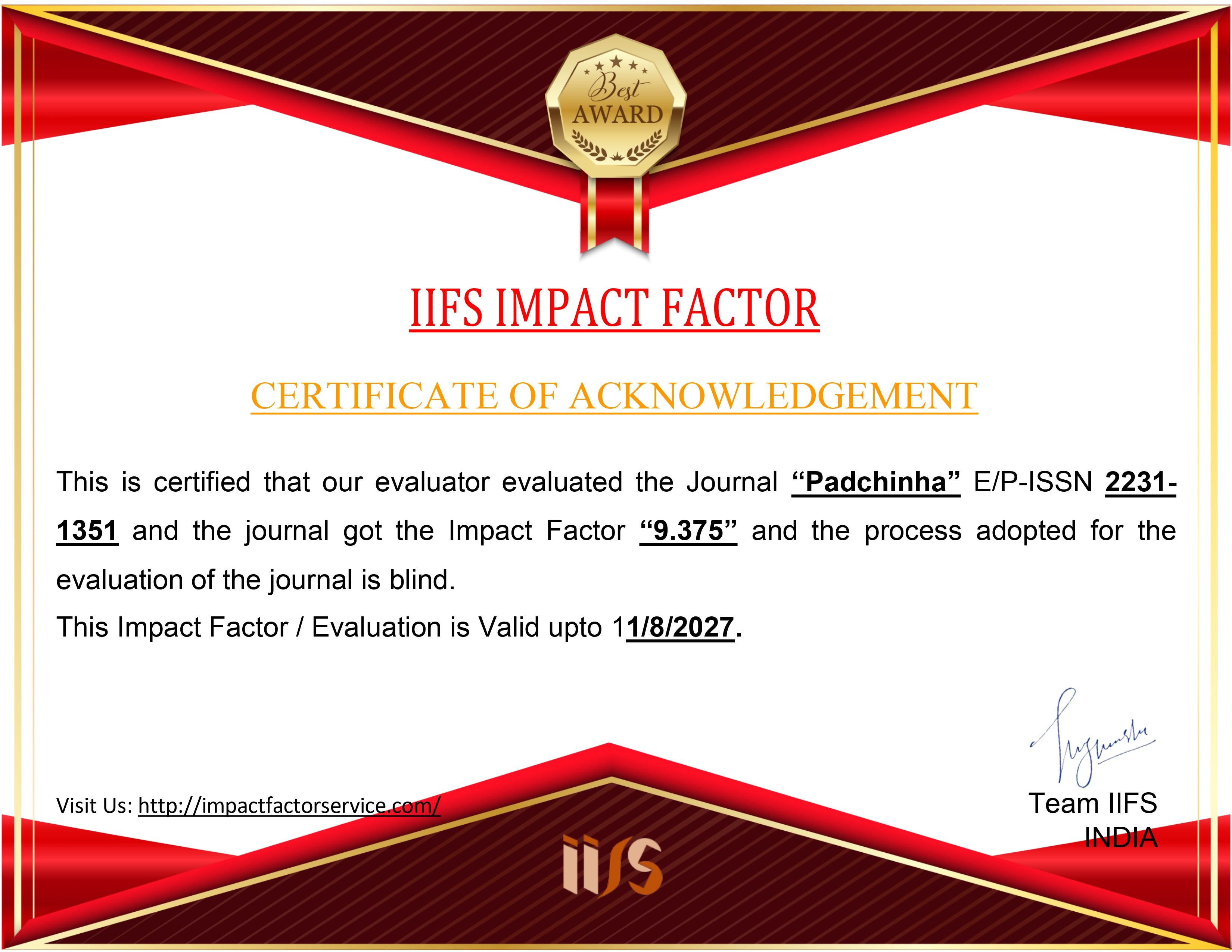
Impact Factor (IIFS): 9.375


भारतीय समाजिक विज्ञा... Read more

महात्मा गांधी अनतररा... Read more
Authors should send all submissions and resubmissions to padchinha@muditeducation.com some articles are dealt with by the editor immediately, but most are read by outside referees. For submissions that are sent to referees, we try to complete the evaluation process within one month. As a general rule, Padchinha operates a double-blind peer review process in which the reviewer’s name is withheld from the author and the author’s name is withheld from the reviewer. Reviewers may at their own discretion opt to reveal their name to the author in their review, but our standard policy is for both identities to remain concealed.
Absolute technical requirements in the first round are: ample line spacing throughout (1.5), an abstract, adequate documentation using the author-date citation system and an alphabetical reference list and a word count on the front page (include all elements in the word count). Regular articles are restricted to an absolute maximum of 8,000 words, including all elements (title page, abstract, notes, references, tables, biographical statement, etc.).
In addition to Regular Articles, Padchinha publishes the Viewpoint column with research-based policy articles, Review Essays, Book Review and Special Data Features.
The final version of the manuscript should contain, in this order:
(a) title page with name(s) of the author(s), affiliation
(b) Abstract
(c) Main text
(d) List of references
(e) Biographical statement(s)
(f) Tables and figures in separate documents
(g) Notes (either footnotes or endnotes are acceptable)
Authors must check the final version of their manuscripts against these notes before sending it to us.
The text should be left justified, with an ample left margin. Avoid hyphenation. Throughout the manuscripts, set line spacing to 1.5.
The final manuscript should be submitted in MS Word for Windows.
Padchinha is a Mutlilingual Journal. The main objective of an academic journal is to communicate clearly with an international audience.
Elegance in style is a secondary aim: the basic criterion should be clarity of expression. We allow UK as well as US spelling, as long as there is consistency within the article. You are welcome to indicate on the front page whether you prefer UK or US spelling.
The abstract should be in the range of 200-300 words. For very short articles, a shorter abstract may suffice. The abstract is an important part of the article. It should summarize the actual content of the article, rather than merely relate what subject the article deals with. It is more important to state an interesting finding than to detail the kind of data used: instead of ‘the hypothesis was tested’, the outcome of the test should be stated. Abstracts should be written in the present tense and in the third person (This article deals with...) or passive (... is discussed and rejected). Please consider carefully what terms to include in order increasing the visibility of the abstract in electronic searches.
The main title of the article should appear at the top of pg. 1, followed by the author’s name an institutional affiliation. The title should be short, but informative. All sections of the article (including the introduction) should have principal subheads. The sections are not numbered. This makes it all the more important to distinguish between levels of subheads in the manuscripts – preferably by typographical means.
Notes should be used only where substantive information is conveyed to the reader. Mere literature references should normally not necessitate separate notes; see the section on references below. Notes are numbered with Arabic numerals. Authors should insert notes by using the footnote/endnote function in MS Word.
Each Table should be self-explanatory as far as possible. The heading should be fairly brief, but additional explanatory material may be added in notes which will appear immediately below the Table. Such notes should be clearly set off from the rest of the text. The table should be numbered with a Roman numeral, and printed on a separate page.
The same comments apply, except that Figures are numbered with Arabic numerals. Figure headings are also placed below the Figure. Example: Figure 1.
References should be in a separate alphabetical list; they should not be incorporated in the notes. Use the APA or MLA format of reference.
The biosketch in Padchinha appears immediately after the references. It should be brief and include year of birth, highest academic degree, year achieved, where obtained, position and current institutional affiliation. In addition authors may indicate their present main research interest or recent (co-)authored or edited books as well as other institutional affiliations which have occupied a major portion of their professional lives. But we are not asking for a complete CV.
Author’s proofs will be e-mailed directly from the publishers, in pdf format. If the article is co-authored, the proofs will normally be sent to the author who submitted the manuscripts. (Corresponding author). If the e-mail address of the corresponding author is likely to change within the next one months, it is in the author’s own interest (as well as ours) to inform us: editor’s queries, proofs and pdf reprints will be sent to this e-mail address. All authors (corresponding authors and their co-authors) will receive one PDF copy of their article by email.
The responsibility for not violating copyright in the quotations of a published article rests with the author(s). It is not necessary to obtain permission for a brief quote from an academic article or book. However, with a long quote or a Figure or a Table, written permission must be obtained. The author must consult the original source to find out whether the copyright is held by the author, the journal or the publisher, and contact the appropriate person or institution. In the event that reprinting requires a fee, we must have written confirmation that the author is prepared to cover the expense. With literary quotations, conditions are much stricter. Even a single verse from a poem may require permission.

भारतीय समाजिक विज्ञा...Read more

वर्ष (Vol.)- 14 अंक...Read more

वर्ष (Vol.)- 14 अंक...Read more

वर्ष (Vol.)- 14 अंक...Read more

वर्ष (Vol.)- 14 अंक...Read more

वर्ष (Vol.)- 14 अंक...Read more

वर्ष (Vol.)- 14 अंक...Read more

वर्ष (Vol.)- 14 अंक...Read more

वर्ष (Vol.)- 14 अंक...Read more

महात्मा गांधी अनतररा...Read more

वर्ष (Vol.)- 13 अंक...Read more

संयुक्तांकवर्ष (Vol....Read more

वर्ष (Vol.)- 13 अंक...Read more

वर्ष (Vol.)- 13 अंक...Read more

वर्ष (Vol.)- 13 अंक...Read more

वर्ष (Vol.)- 13 अंक...Read more

वर्ष (Vol.)- 13 अंक...Read more

के. एल. ई. संस्था, क...Read more

वर्ष (Vol.) - 9, अंक...Read more

वर्ष (Vol.) - 9, अंक...Read more

November 2016

वर्ष (Vol.) - 5, अंक...Read more
Impact Factor (IIFS): 9.375
Padchinha is a prestigious multidisciplinary peer-reviewed and refereed journal committed to advancing knowledge across diverse academic domains. Published monthly with an impressive Impact Factor of 8 (IIFS), it adheres to the latest UGC guidelines and follows APA 7th Edition formatting standards. The journal bridges the gap between academia and society by publishing high-quality research that addresses real-world challenges. With ISSN 2231-1351, Padchinha welcomes original contributions in science, sociology, education, economics, literature, and management. Our rigorous peer-review process ensures scholarly excellence and intellectual integrity. Padchinha transforms research into meaningful social change.